Hi there,
Amazing listening party last night for the Loula Yorke Live Compendium. I couldn’t believe how many folks tuned in – Bancamp tells me 70 people dropped by, thank you so much!
I used the listening party chat window as a forum to canvas questions for an AMA. I decided to gather them all up together into a Google Doc and answer after the session, as I really wanted to do the questions justice and the chat window was very tiny and time was short!
Herewith my replies written after the stream ended last night. They are quite long so make a cup of tea and find somewhere comfy to sit 🙂
Q: I would love to hear your thoughts on this: how do you balance the obvious instant improvisation vibes modular provides, the process of building a patch (for me what I’m most excited about), and then the sort of obsessive process of recording the patch and taking detailed notes to repatch and perform a track over and over at different times.
A: I’ve been noting down my sequence numbers and patches since I wrote Volta in summer 2023, spurred on by the challenge of wanting to perform some material from that album live with some degree of repeatability or accuracy (lol). At first I noted down every little thing in the spreadsheet but it became quite overwhelming and hard to pick out what was important to the actual sound or structure of the piece, and what was just “this is where these particular patch cables happen to be at this time but nothing turns on it in fact”. So now I really only focus on the absolute basics of the patch: what is the bpm, where is the pitch information coming from and going to, which oscillators and wave shapes am i using, where are the gates and envelopes coming from for each voice, what modulation is going into the filters, what is the delay time. I will note down some kind of description of the structure, ie ‘how to play the piece’, but again keep it to headlines only. I also record it live as soon as i can so i have some kind of aural record to cross-refer the notes to. And then I can ignore it all if i like but at least i know what the notes are relating to! Another reason for doing this now is that otherwise I have all these sequences saved in all these banks with no idea what’s important and needs to be kept safe, and which ones i can overwrite/modify/recycle.
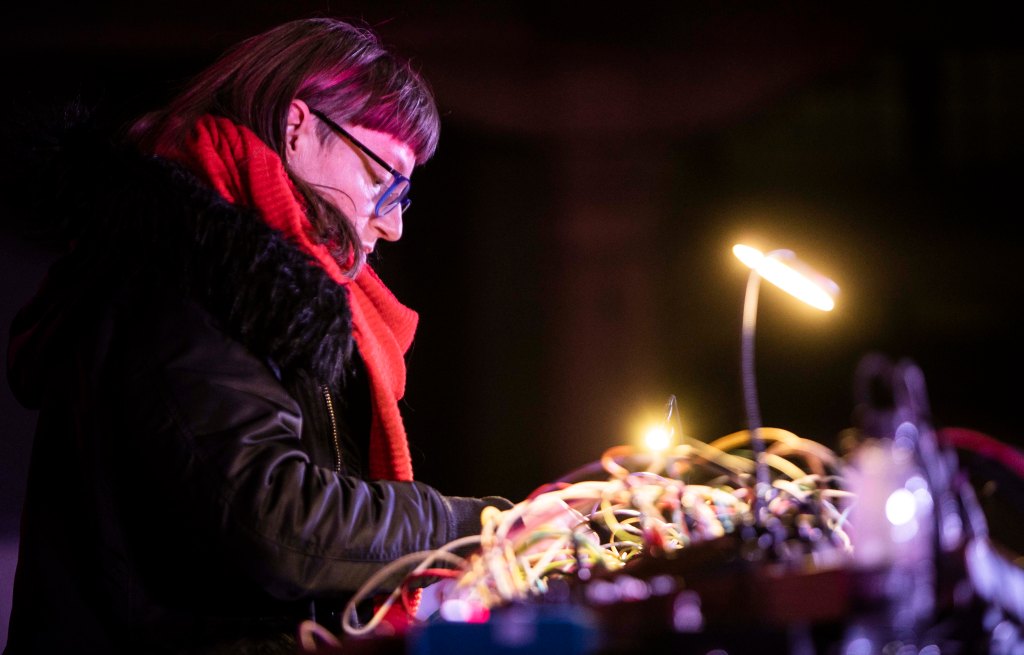
Re the balance between improv and composition – I’m having a really weird time with the idea of improv at the moment because I don’t know if what we call improvisation in our world is improvisation at all in the sense used and practiced by ‘masters of the craft’ like AMM, or other groups of musicians sitting together very intensely listening to what each other are doing and chiming in only when necessary (I saw Fuck Batman recently – wow!). I’ve never managed to do that with anyone, even when we’ve been doing unplanned playing at the same time, I find it really hard! Are we ‘improvising’ or are we just playing our synths solo at the same time?
So, I am careful to say ‘sequenced with room for improvisation’, and by that i mean:
adding quantised pseudo-random pitch information over the top of another sequence
changing notes in a sequence on the fly
altering the length of the sequence or play direction
deciding what oscillators to voice it with – quiet? loud? add different harmonics?
bending those sounds around – ie adding glide!
fucking about with this or that filter a bit
changing the octave
tweaking an envelope (for a filter or a VCA)
changing the offset or the number of steps in a euclidean rhythm
there are lots of others, can’t think rn!
– which, idk, is that even improvisation, or is that just how you play modular? Like, those are the things we learn to do naturally as we get better at playing our instruments, rather than anything to do with improvisation vs composition, if that makes sense?
When I say “that is how you play modular” I understand and accept that it’s not how everyone plays it! I should say “that is how I play modular”.
Final thoughts on improv is that i think modular is amazing for avant garde atonal formless textural improvisation but that it’s not where I’m at at the moment. Mainly because if I wrench the frequency knob around to do some fun cross-modulation or something then I lose the tuning and i’m actually basically scared to do that mid-set because i’ve no idea how i’d get it back in tune again to finish the rest of the pieces … altho I have just bought a digital tuner so i could technically do that and have some kind of visual reference to put it right afterwards – i’ve just realised as i’m typing this lol.
Q. Which tone reeflects the blue?
A: My mum asking the big questions here.
Q: Hello Loula! How do you approach improvisation? Modular is a weird world. Do you start from a patch you developed and work your way through it? Do you use mental images? Dynamics?
A:I have no relationship with thinking of music visually, like using any kind of mental image: graphic scores bewilder me completely lol. For me it’s about listening and responding to what’s coming out of the speakers, getting into a feedback loop with the instrument.
I used to start by patching stuff together and making weird noises, and then allowing a rhythm or some kind of change in the sounds that repeats in a somewhat predictable way to emerge, and just eschew ‘notes’ entirely – the track Now We’re Cooking on Jazz is a great example of a one-take improv where I did that (available to Cottage Studio subscribers and Castles in Space subscribers). I absolutely LOVE doing that but it’s not where my head is at the moment at all.
At the moment, I start by choosing a key and writing a sequence in that key, usually based off an arpeggio that goes up a scale one way and comes down again slightly differently. It’ll be playing through just one voice with some reverb, and it just goes round and round. Sometimes I might use the Quantermain app on the Ornament+Crime to get some notes going round. Basically I’ve got to get a repeating cycle going. The continuous stream of sound is important, I have to listen to sometning and respond, even if it’s just a drone.
Then I’ve got two approaches: either it’s a long sequence, in which case I start to remove (ie mute/silence) notes, so they’re still in the sequence but they’re not being played, and also start to send notes to different voices. So it’s one sequence but it’s being split across different voices. Then I’ll save iterations of that and move between them, gradually bringing in all the missing notes to reveal the full sequence and then removing them again. Track 1 ‘The Open Independence of Her Seas’ on the Live Compendium is the product of exactly this process, so is ‘The Grounds are Changing As They Promise To Do on Volta.
Or I’ll write a much shorter sequence, like Track 3 ‘Success in Circuit Lies’, with the intention that it will end up as a basis for harmonic stuff to start to happen on top, could it end up being backed by a chord progression, could it have melodic stuff on top from the Quantermain, could it have a single note droning away beneath it for the duration of the piece, could it change length, could it be played backwards, could a whole new section of notes be added that changes its character entirely, could it be voiced by a really quiet synth, then a really loud one or vice versa.

In terms of improv with soundworlds, I’m just so tame with that at the moment – it’s all just sines and pulse-widths and saws and stuff – because I’m really just learning about and practicing harmony: i’m self-taught and until i bought a second and third oscillator everything was monophonic and i had no way of making chords, so i didn’t even consider them as a possibility, but that’s all changed, and now i’m practicing ‘music theory’, if you like. And i’m *so* focused on that (because it’s totally new to me since late 2022 / early 2023 – iirc SKIM from YOUL is the first track I ever tried to use a simple bassline chord progression with a melody line on top), that I’m not thinking much about getting complex sounds out of the modular. I feel I can’t risk detuning my complex oscillator to really dig into its amazing capabilities in livesets because I just really want to explore harmony atm and I need to keep it in tune. I think I have managed to get something interesting going texture-wise in ‘Function We Must’ without detuning anything but it was a struggle.

Q: Without getting too bogged down in gear q’s, what are you using to sequence? And are the melodic components pre-saved or are you entering them as part of the performance?
A: I am using the Erica Synths Black Sequencer for main sequences, which are pre-saved but can be edited ‘on the fly’ in a non-destructive manner (ie it won’t save the changes unless I want that to happen).
Some of the toplines are coming from the Ornament and Crime Quantermain app. These are pre-saved starting points but as you change the probability they start to morph. I also add control voltage to change the range so they move up and down to give variation.
With both the Black Sequencer and the O+C I am flipping between using the different triger options in the Temps Utile, and/or the Gate / Mod Lane trigger / ADSR outputs on the Black Sequencer for envelope timings / information. So the sequence will take on a quite a different character depending on how its envelope / VCA is being set up. Setting these up is what a lot of the repatching is relating to between my pieces on the Live Compendium.
Q: gear related….what do you reach for first…
Sequencer (at the moment anyway).
Q: Do you think it is important to repatch between tracks? It is easier to just stick with the same routing but I wonder whether the challenge is to change it as every patch makes you think differently.
A: I wish I didn’t have to repatch, but I just really like some of the things I’ve written and I want them to sound a certain way and what makes them what they are is spread across so many different variables that they would sound totally different if not set up ‘right’.
Also i often have to stop and start the transport on the sequencer when changing banks to get it to come correct!
That said, I would like to start trying to be less fussy and just move between the tracks / patches while the transport is playing and just work with what i’m faced with, but this is much easier in the studio than in front of an audience. I actually don’t want to have a public battle with my instruments and waste precious time in a room full of people listening to something I hate. I was having a really hard time playing live and my friend Laura Cannell was like: Be honest, do you like what you’re playing? And I had to admit I didn’t. And she was like, fren that is your problem. Write something you like and learn to play it!
At the moment doing otherwise genuinely feels like a wasted opportunity to me. I’ve got a wonderful soundsystem and an engaged audience, why would I want to squander that by leaving it all up to chance? It’s why I stopped turning up to gigs with an unpatched modular and just being like “whatever happens, happens” like I used to do for years. I realised it was making me feel very unhappy because I had really unrealistic expectations of my skills with the instrument that I felt I was falling short of. I started off playing live by doing a lot of DIY noise gigs where folks are really supportive and forgiving and appreciative of unstructured sounds of course, but still to me it was just not working and all i could hear was errors and horrors.
Q: Follow up/related: do you roll up on stage already-patched? If yes, how are you prepping? Practice takes? Etc?
A: Yes I patch the cases together during soundcheck. I do routing the night before, label everything that needs to be unplugged so it’s not a surprise haha. I make a set list with just the BPMs and sequence numbers, and the most important patch changes and stick it to a blank panel in the modular so i can see it during the gig. I practice a lot in the week leading up to a liveset, from full run-throughs to technical rehearsals where i just do the patch changes between the pieces. I try and do two hour-long sessions a day, either practicing the whole thing in one go or going over bits that are going wrong a few times.
Q: I always wonder how you know when to stop twisting knobs/pushing buttons/connecting wires…
A: All I am doing is focused on trying to keep the sound moving, by sounds i mean the timbres essentially. Even if the sequence is the same thing over and over, you can make it sound really different by changing an envelope length or a filter cut-off or a waveshape. I want to wring every last bit of variation out of a very simple set of notes. So yeah, um, by listening is how i feel when to stop: asking myself in a split second “has what just i’ve tweaked done *enough* to change the sound *for now*?”…. but then, “ok when does *for now* end?” It’s a never-ending feedback loop. When I get bored or I think i’ve rinsed that sequence for too long I’ll change to another piece completely – which at the moment means changing a lot of the routing, which breaks the flow completely, so it can be a hard call.
Also I realise all this movement can look a bit frantic at times and I do now start my sets with a totally sequenced piece where all i have to do is bring in different voices and modulations and i actually force myself to stand still with my eyes closed for the first 2 minutes of the set which is my chance to relax and connect with the soundsystem and the room.
Q: How much has having your own studio space – a room of your own – impacted on the amount of music you make and your overall happiness?
A: Thanks for your question Jo! My own studio space is actually a corridor with some bits of ply to block it off to make it into a ‘room’! I just feel I need to say that to show that you really don’t need much. But yes, totally revolutionary. I go there every day I can and i shut the ‘door’ (lol). I would say, however, that what has really impacted the amount of music I make is the decision (which has happened fairly organically and very slowly between 2019 and today) to concentrate on music full-time. Having a dedicated space and now having my kit set up permanently meant that decision was far, far easier to make.
Q: To Orlando’s point, maybe also describe your relationship/ideas/sonic philosophies on duration.
I honestly don’t know. I worry my tracks go on too long, and that an audience might lose focus whereas I’m totally in the zone because i’m doing the tweaking so i’m totally living in the moment, so it’s a tough call for sure. I do save iterations of sequences so that if I’m like “right that’s enough of this now”, i can press just one encoder on the sequencer and something will iterate without me having to pfaff around step-writing it in live.
Q: Questions (I have a ton, sorry!), How does a specific track develop for you initially, is it over a course of days or longer? Suzanne Ciani mentioned that she just lets things run for days around the house, getting familiar and then letting them grow as they sort of emerge from a patch.
A: Days, for sure. My sequences just go round and round until I work out what to do with them! I used to do it far more with patching – as in, randomly routing CV and audio round a system to create cool and mad coincidences – but that’s for stuff that I aim to record and not intend to recreate live. If it’s for a liveset I have to know the sequence inside out and try all the variations.
Q: Here’s another Question, (haven’t been able to see you play live yet) How important is it for you to have a very locked and set system. Videos I’ve seen of you playing, you are always in motion making small tweaks and adjustments, playing every part of a complicated system. How long does it take you to get that sort of familiarity so that this all happens at an instinctual level – especially since it’s a complex system?
I have been using this set-up since spring 2023. And I think I’ve just about got the hang of it. So, 18 months to 2 years? I haven’t added to it all really in that time bar adding a couple of switches to use as instantaneous mutes for the drum sounds, and then one big change which was switching out an STO for the CSL last January so I could try to get some more complex synthesis going – but i’ve hardly scratched the surface with that! Function We Must is the only thing I’ve managed to make work on that front so far. I feel like I am wasting that module completely but anyway haha
If I may indulge with a sidebar re length of time when viewed through a cost:benefit analysis lens is bananas. Just to make sounds you could make on a computer in 10 seconds. You know that meme with a cartoon of a “Learn how to make a trombone sound in 10 Weeks!” And every time I add a module I go back to square one and have to learn it all again – and there is the nagging worry that it sounds so simplistic and naive compared to the effort and the number of modules that goes into making it happen, you know, the very real issue that eurorack by itself is not actually a ‘good’ live instrument when compared to something designed for electronic composition and live performance like an Octatrack or Max4Live or Ableton. So I have to remember (or believe!) that I’m working in the same tradition that blends this (video: Suzanne Ciani: a masterclass in modular synthesis) with a sweaty Roland TR-808/TB303 workout in Chicago or Detroit in like 1985 – creative spaces built on showcasing very big, simple, blocky, wide-frequency analogue waveforms that just have a weight and depth to them when played through a massive sound system that is 100% worth listening to, and that this ludicrous, unwieldy experience is worth fighting for so other people can experience the power of them in their rawest form. That the extreme simplicity – and even naivety (of my music at least to be clear! Not saying other people’s music is naive!) when listened to through contemporary electronic music production ears is actually a large part of the charm in my experience.
Q/A: Someone asked a question about my rules for harmony but it got deleted by mistake. So I’ll just say I have no rules. I am the basic bitch googling ‘what is good chord progressions in A#’ and clicking on the ChordFiles adverts on instagram. I’m teaching myself here in realtime and sharing the results with you as they happen in my mixtapes and albums. Harmony is all new and exciting for me since I even started considering it in 2022/2023. Fans of Olivier Messiaen’s tonality can keep walking (for now!?).
Q: Given Kevin’s info about what a patch is, how reproducible is this? If you wanted to play this in exactly the same way in another setting, would that even be possible?
With practice you could do it exactly the same, but for me it wouldn’t be fun or rewarding in any way at all. I’ve never managed to do anything exactly the same twice. I can play the same sequences in the same order but it still doesn’t sound ‘the same’. I don’t think I personally would have the patience or the aptitude. But if you think about a concert pianist, and what they go through to learn a piece, yes a human could decide on and note down and then learn every knob tweak, every split second timing, I think yes it’s technically possible.
Q: Track titles, are they titled after the fact? Or a way to set an intention before?
A: After the fact. I have lists of lines or phrases from novels and poems and I go back and look at the list and see what moods fit with what sounds.
Q: Not sure if this has been asked but, do you have a favourite bit of kit and if so, why is it your favourite?
A: I always say the Radio Music and the Clouds together, because once I played a really small show in a tiny DIY space on my Innalog modular and nothing at all worked except a TR-09 drum machine running through a distortion pedal, and the Radio Music running into the Clouds, and luckily whatever module was triggering the RM and CVing the parameters on the Clouds was doing its thing and honestly everyone loved it and was dancing their butts off in this tiny boxroom and didn’t notice that nothing else was even making a sound.
Q: What’s your fav filter like we heard about 15 mins in? And prominent on “the steams sent forth…” three sisters?!
A: I use a Doepfer SEM filter and a Jove filter. I can’t choose between them 🙂
Q: Do you prefer live performance or the studio?
A: The studio because there is less pressure and I don’t have to set up everything from scratch before I play.
Q: the voices, field recording or from a movie/show?
A: I’ve been trawling youtube and collecting long form audio for years. I choose things without background music, very often women’s voices that are quite clear and bright-sounding so they can stand out against hard-sounding drums. I use the same ones over and over, I know them off by heart. Anything – vintage cookery shows, documentaries, slam poetry, chatshows, science presentations. Also the BBC Archives are fun. My favourite long form sample that I use is Tracey Emin storming off an art criticism TV show after winning the Turner Prize, ripping her lapel mic off and shouting “Is this real? Are people really listening to this? Are real people in England listening to this?” But the way they come through you only ever get to hear these randomly-chosen re-ordered snippets.
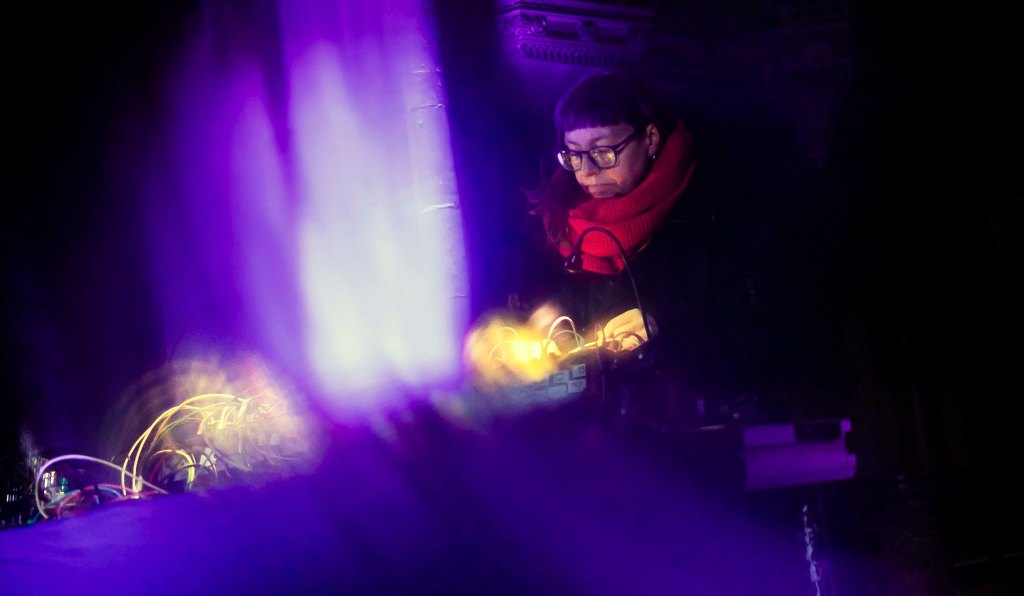
Q/A: Someone asked how I made the artwork and I think they meant the CD cover art – and I answered it in the chat – it’s a photo of me playing live that has been altered in Photoshop by trying out different blocks of colour both underneath and over the top ,and playing around with the ‘blend mode’ on each layer. I think I also adjusted the colour balance in the OG photo too. I’ve included the original photo somewhere up there in this blog post!
—-
OK, thank you so much, amazing listening party last night. Packing your orders now

 Loula Yorke