25th April 2024
Time codes are in bold | Track titles are in italics
Olympus LS-100, iPhone, piano, modular synth, DAW.
00’00 Dawn chorus from the kitchen window. I didn’t sleep too well last night after making the announcement on social media that I was launching a ‘monthly ambient mixtape project’. My jaw and neck and upper body were really tense all evening. At 4.25AM this morning I bolted awake and thought “well if this is how it’s going to be, if I am indeed a sound recordist now with a monthly ambient mixtape project then I’d be a fool not to get out of bed and record this stunning dawn chorus to put in it”.
03’40 Snow in April
Two years ago this April it snowed. Soon after, I heard the news that the composer Mira Calix had died. Or at least that’s how I remember it. In fact the timeline doesn’t quite match up, which is often the way of our imperfect emotional memories. What I do know for sure is I was sent completely sideways for a while. Calix was a symbol, a waypoint, an anchor, a generational marker in women’s participation in the tiny little corner of 90s UK electronic music that I take an interest in. Importantly, she opened up a world beyond it: a world of composing for public art installations and dance pieces and classical orchestras in stark Modernist concert halls – all without being ‘classically trained’ or using standard notation (until later when she wanted to, and did, learn to employ it). All this while living in Suffolk, 20 minutes down the road: when she posted videos of herself dancing in the woods, they were woods I recognised. Calix was always supportive – as she was to every woman in music she chatted to: I don’t want to imply a closeness that never was. Until she died I never realised how profoundly comforted I was by the thought that she was there and she was doing it. Last week I found an old recording of an improvisation saved on the SD card of my sound desk made in early April 2022, entitled ‘SNOWAPRMIRA’. I felt it was time to do something with it to mark the 2-year anniversary in my own small way.
At the risk of ruining the rhythm of the writing, I felt I should share a bit of technical information as I know that many people who follow my work are also busy making their own, so here it is: all my improvisations at that time were made using a Turing Machine Expanded fed into Ornament+Crime ‘Quantermain’ and voiced by a 4ms Vector Synth. Feel free to reach out with questions.
09’06 It’s now 5:05 AM and I’m making a cup of tea. I’ve brought the sound recorder in from its perch on the windowsill and put it on the draining rack by the sink. I work on pulling something together from the Snow in April recording until it’s time to wake the children up for school.
10’26 Here lies an edit of my track Eala which came out earlier on April 19th on Ian Boddy’s Tone Science 9 compilation.
14’28 The other day I watched a 1986 documentary about avant garde composer Cornelius Cardew on my laptop by the fire. Long drones recorded live using my current modular set-up. Delay and gentle panning added later.
17’04 Hail on a velux window. Natural sonic textures to die for.
18’44 I spend a good deal of time here washing up at this sink. I don’t mean to make it a gendered thing, it’s more that our dishwasher broke a few months ago and I work from home.
20’52 Removing a pair of Marigolds to answer the phone. This is as close to an OnlyFans as this offering will ever get.
21’14 Now We’re Cooking on Jazz
This is a live improvisation made with my Florescence-era recording set-up. I didn’t want to use ‘notes’, so there is no pitch information going into the oscillators. The piece is created using the same idea of timings and rhythms described down the page there, with live granular processing, a dub delay and a strymon bluesky pedal for reverb.
27’08 Making an omelette to the sound of a podcast. Andrew Hickey is telling the story behind Jimmi Hendrix’s version of All along the Watchtower. While the eggs sizzle in the pan, Andrew is talking about transistor technology and early forms of guitar pedal.
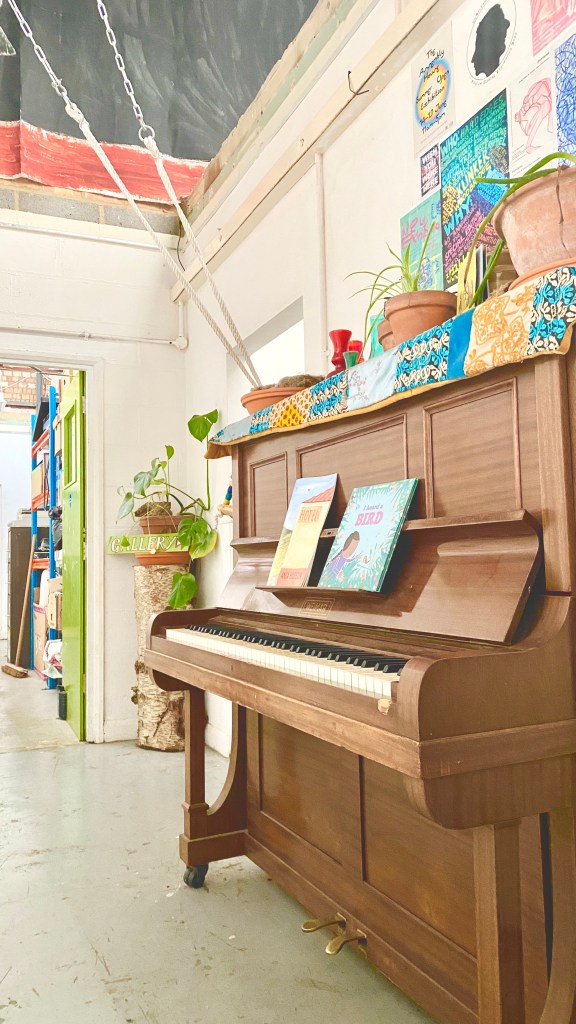
31’26 I am noodling around on the piano that stands in the front hall of Asylum Studios. A couple of the keys don’t work but it’s fairly well tuned.
32’26 Even more dramatic hail on the velux window in my bedroom.
32’41 First pass edit of a new pattern I recorded live last weekend. This is a classic way I start off a tune: a couple of arpeggios pinging back and forth through multiple oscillators. Voices are plucked at different times by envelopes/VCAs triggered using random and euclidean timings. Control voltage affects the offset or randomness of the timings and the morphing of the delay times. It’s all finished off with a reverb pedal. The stereo panning and another layer of delay gets added later in a digital audio workstation.
36’42 A walk round the field a couple of weeks ago.
It started to rain. I recorded the sound on my phone which I held out at arm’s length beside me. ‘The field’ is going to feature regularly, as it does in my life. I now have the opportunity to write down the most pretentious artistic thought I’ve ever had, so buckle-up buckaroos … “Walking is part of my practice.”
38’20 The sound of the pipe at the end of the field when it has been raining solidly for a few days.
East Anglia has a pretty rich and watery history as it’s so flat and so much of its land was claimed by humans and diverted from its natural wetland state in the middle of the last millennium. Not to be outdone by their ancestors, the Victorians went crazy for agricultural field drainage: between 1840 and 1890 they managed to drain 12 million acres of land in England to create better growing conditions for arable crops. I stand very still and listen out for the most beautiful and delicate harmonics that arise when the rushing water hits a full stream in the ditch below.
39’57 The sounds of the secret wood.
The vast majority of England and Wales is entirely unknown to us because we are banned from setting foot on it. By law of trespass people are excluded from 92 per cent of the land and 97 per cent of its waterways. There is a network of footpaths and rights of way, but they are sometimes blocked and rarely signposted: you have to ‘know about them’ to know about them. As my children have grown bigger and either have long enough legs to walk places, or are old enough to exercise their right not to accompany me, I have been able to roam further and further away from the house on foot. After 15 years living in the same village I only very recently – like last-Autumn-recently – came across an ancient byway of a few hundred yards leading to a small copse, about 30 minutes walk into the countryside, far away from any audible roads. A battered and sagging string of rusted barbed wire hangs limply along part of one side of the copse: a pointless gesture but a gesture nonetheless: “the existence of a border implies the violence to maintain it”, as Ayesha Siddiqi would say. On the other hand there is a very definite path made by generations of feet, circling off the byway into and around the copse. I’ve brought my sound recorder.
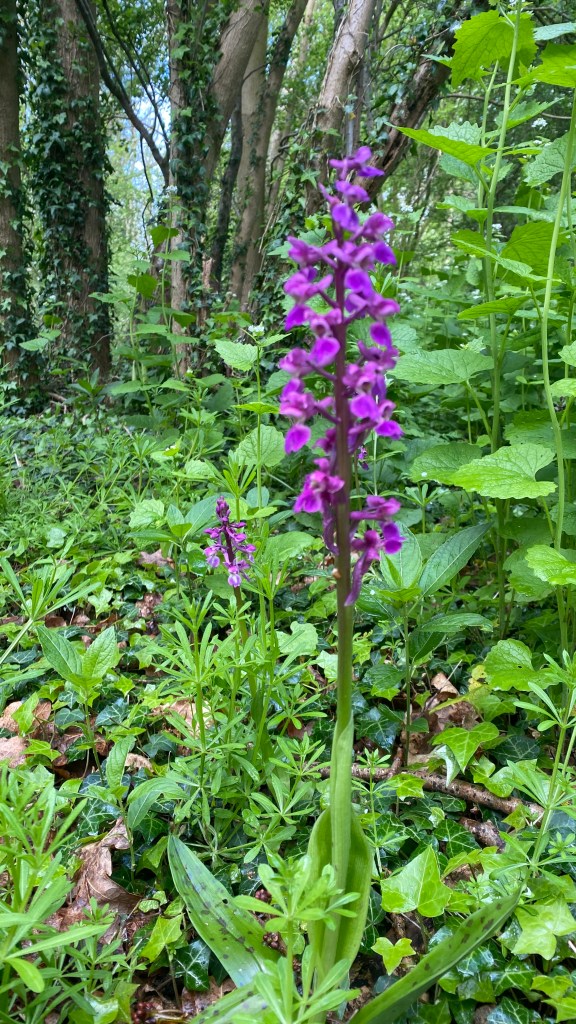
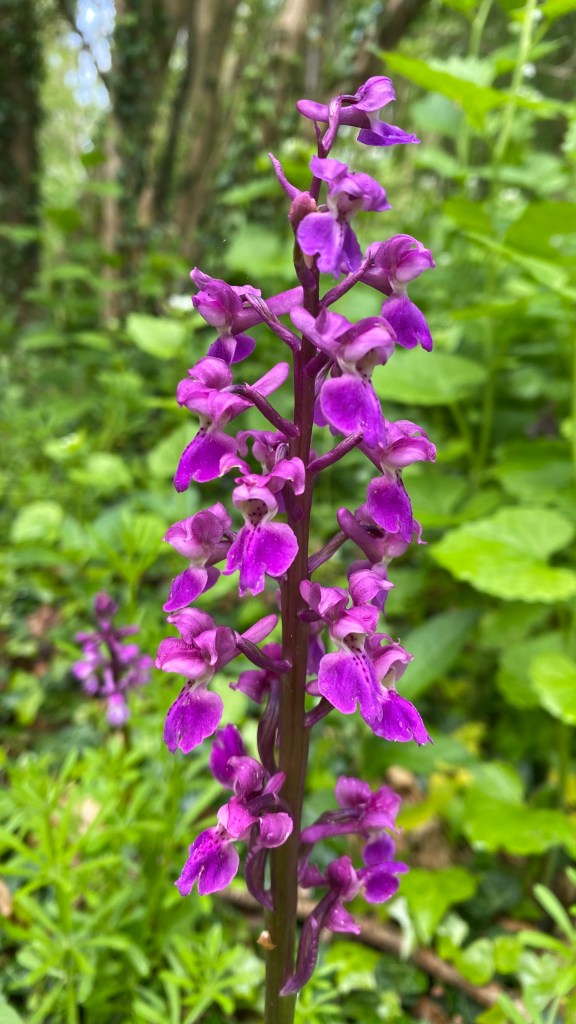
Because there is a bit of a stiff northerly wind I want to find a tree to nestle it in; the windbreaker probably won’t be enough. I’ve decided to turn the recorder on, leave it and walk around the path around the little copse in full, picking it up on my return. I spy a suitable stump of coppiced Hazel for protection. Walking towards it I see what at first I think is a mutant bluebell – I don’t dare dream it would be anything interesting – but turns out to be an absolutely stunning early purple orchid.
You are now listening to the full 10-minute audio of the secret wood; all the time I was away from the recorder. It is layered in places with some collages made from a recording of me tuning up my oscillators earlier in the month, and a smidgen of audio from the sounds of the spaces between (which I posted up last month as a Cottage Studio Subscriber Exclusive). In the field recording you can actually hear what sounds like insects munching. In the piece of sound art you can hear the delicate sounds of button-clicking. I wanted to situate these together.
48’18 A 20-second clip of a recorded conversation I had with Nicola Kearey which went out on Noods Radio on April 9th. I am talking about motherhood and limitations and the power of getting on with it.
49’10 Boots approaching your ears in glorious stereo across the driest and crunchiest bed of leaves. If one is allowed favourite sounds this would be mine. It won’t be the last time you hear of this!
49’33 I set up the recorder in front of me while I rehearsed the other day. This is a new sequence I’m working on. You can hear me moving around, clicking buttons, letting Rosie the cat in (she doesn’t have a flap), and wrenching those envelope and filter knobs around: I want to get that square wave to really squeal, those delays to cascade and the attack to really pop. I wanted to breathe some new life into my studio recordings and see if I can capture how it sounds when I’m composing in a real room.
53’25 Switching from room audio to sound desk audio, which brightens and deepens the sound. I’ve changed oscillators from the square wave to a set of harmonic sines, playing through the same sequence again but with a different delay time, adjusting the delay time and the balance of harmonics as I go.
56’36 fin 💫 thanks for joining me. look forward to meeting you here again next month.
stray links
Song 173: “All Along the Watchtower” Part Two, The Hour is Getting Late
“The Book of Trespass: Crossing the lines that divide us” by Nick Hayes
 Loula Yorke