Salix is a work-in-progress exploring the ancient roots of willow trees in magic, myth and medicine.
Salix is the Latin word for willow (saileach in Irish, or seileach in Scottish Gaelic).
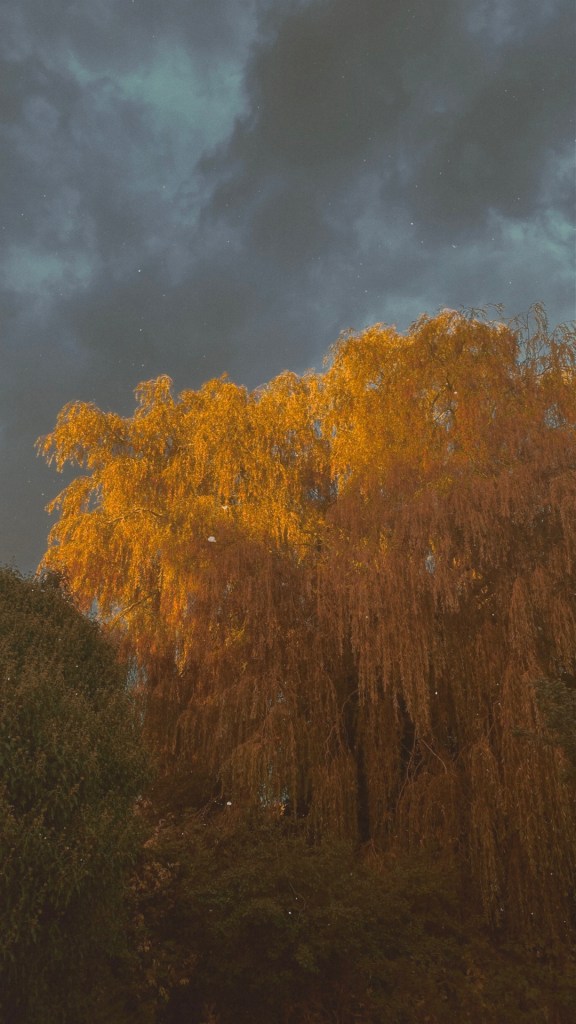
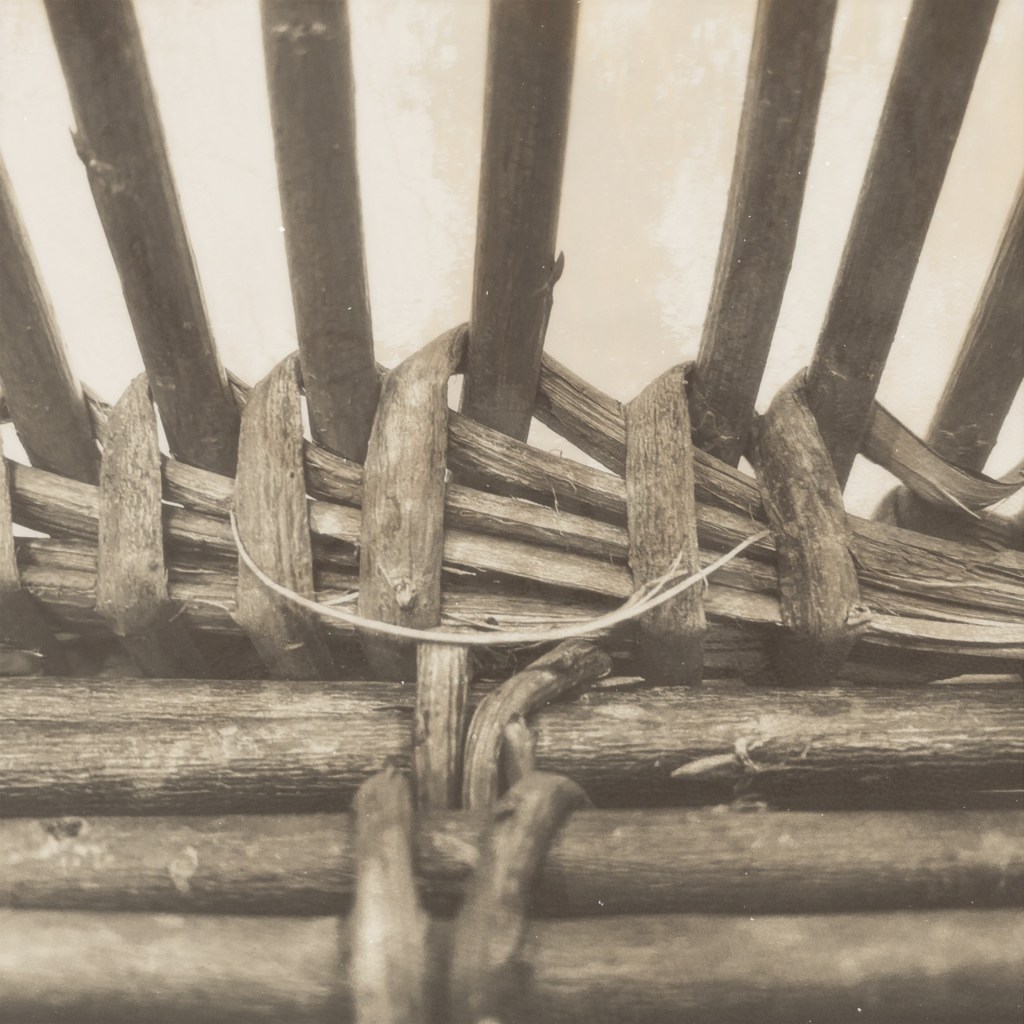
Below is a photograph of the weeping willow on the Green by my house. Watching the changes in this tree over the past twenty years, between seasons and cycles, inspired the subject of this project. As part of the preparation I visited the V&A Storehouse to handle some willow-related objects; the first of which is a woven willow oval open-work arm basket. The original carrier bag.
On 2nd October 2025 I released the EP Salix One for the Cottage Studio subscribers on Bandcamp. The EP comprises three live recordings of improvisations, two of which feature woodwind jazz wizard, Charlotte Jolly.
The instrument I am playing is a 1881 Smith American Style 100 Reed Organ (not a modular synth, you will notice). I really needed a break from programmable instruments, and I’ve found using the reed organ incredibly freeing. The experience sent me into my autumn gigs as special guest on Brìdghe Chaimbeul’s tour dates with something totally unlocked in my head – it was incredible.
The reed organ is in poor shape: unserviced, some keys, stops and reeds are broken or loose; it’s not in tune, and does not track evenly across octaves. I also can’t ‘play’ keys. I have no technical ability. My idea, which I felt I achieved, was to use the organ to create drones.
Charly brought along alto and bass clarinets, of which she is a virtuoso player and master improviser.
Charly and I met some years ago when I was guest composer on a Britten Pears Arts community music project where she was a music leader. We wrote and performed some material together with a group of young people as part of the Group A project for Firstlight Festival and Ipswich Music Day in 2022. Although we stayed in touch, we hadn’t played together since.
Fast forward to 4th September, 2025
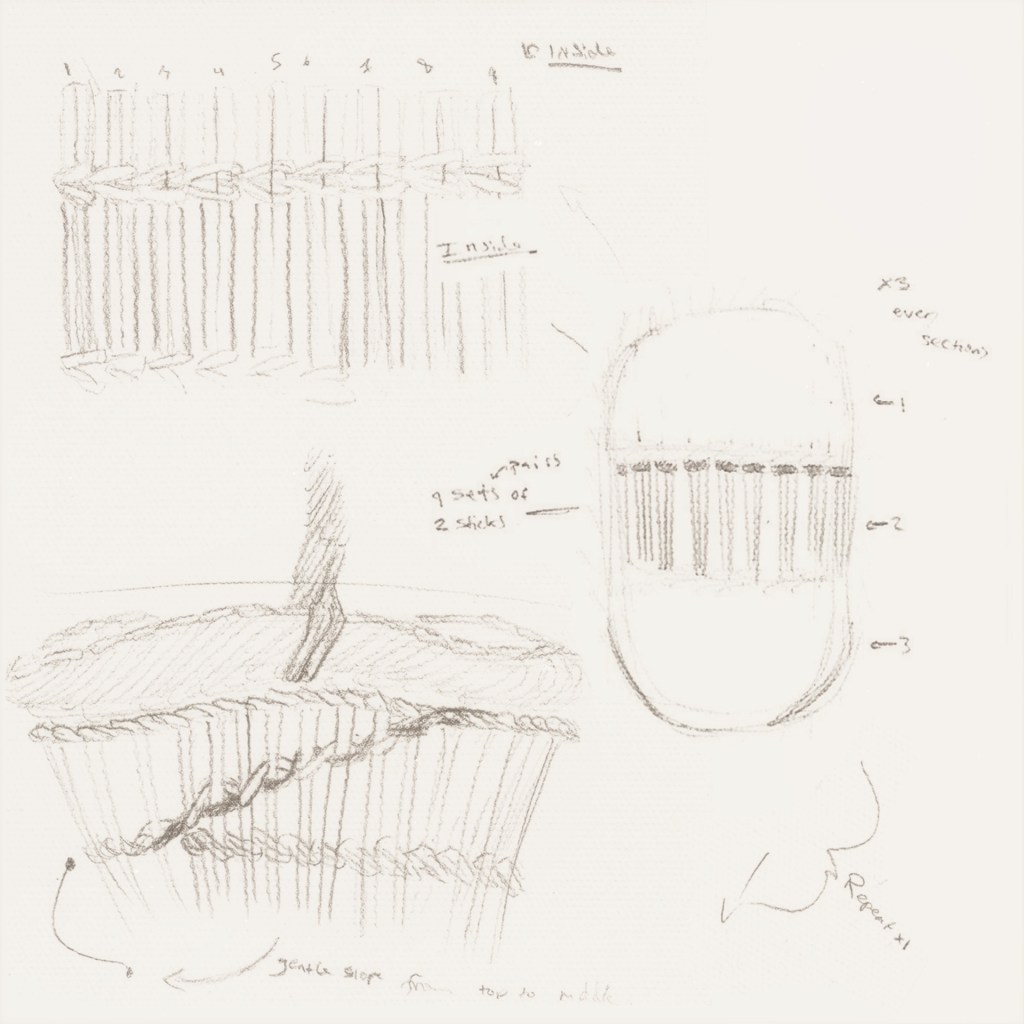
Charly and I sat together in Studio Four and played one evening. I brought along some some pencil sketches of an oval arm willow basket from my visit to the V&A East Storehouse, woven by Jenny Crisp (1992, V&A T.174-1993). These were propped up on a music stand somewhat optimistically. We thought about all that space in an open work basket; how its structure comes from repetition, but it still needs that one single beautiful encircling curve to hold it together.
I shared what I knew of the story of Orpheus: how a lyre carved of willow wood was responsible for his whole doomed love affair; that in some tellings of his journey to the Underwold he carries with him a bundle of willow under one arm for protection.
Charly and I talked a lot about DIY music as a liberatory practice that night: one take and we’re done, make space for vulnerability, try not to obsess over the finesse. We wanted to sketch out something that stands in contrast to how making music can easily start to feel when we’re bombarded by advertising for new gear, endless feeds of how-to videos about how to get your mixes louder, slicker, spicier; how to “make it”, “get noticed”.
In ‘the carrier bag theory of fiction’ Ursula Le Guin outlines her ideas about the role of technology in storytelling. She urges us to focus our stories on the container, a tool used since the dawn of time to foster, gather and sustain, rather than on the solo techno-heroic set on a linear path to domination.
Salix One owes it all to the original ‘carrier bag’.

SALIX ONE sample pack
On the same day as the EP, I released an accompanying sample pack. Some thoughts about the sample pack in no particular order.
This sample pack is a concept, ok? I’m not sure I expect anyone to find it useful as it doesn’t have the kinds of sounds you would normally expect in a sample pack, like drum loops and stuff. Instead it features a lot of odd sounds made by the Smith American harmonium and a bass clarinet.
I learned a lot about de-noising while making it.
It’s spooky as fuck and arriving just in time for Hallowe’en.
The sounds are for your own use. Load them into a sampler or a DAW. Koala sampler app on the phone is good! Sequence them up, add some FX, and away you go. One Subscriber has mentioned playing them at random in VLC player and frankly this seems just as valid a method as any: a new EP reconstituted and composed by the listener at random – Fluxus would be proud.
The samples are in mono in 24bit/48kz. You can easily convert them to stereo if you need to.
Spending so much time with individual notes and different stop placements on the reed organ gave me a chance to study in detail how extremely strange this instrument really is. Some of the keys quite literally whistle. The treadle ceaselessly creaks. Undertones and overtones arrive late. The whole body of the instrument rings and hisses.
The organ doesn’t track well across the octaves, and all the notes are a quarter to a half tone flat. The reeds are made of brass. They are not sensitive to temperature or humidity. The reed on a clarinet is made of –– well, it’s a natural material, it’s a ‘real’ reed. It’s very sensitive to everything.
Luckily, clarinets can be tuned and de-tuned, both in the preparation and the playing.
Charly was amused by me asking her to do this whole sampling thing as apparently “playing your intrument” (as in tapping the keys but not breathing into it) is some kind of contrived activity they make you do at orchestra practice.
Thanks for your support in this space. You are golden. Until the next instalment!
 Loula Yorke