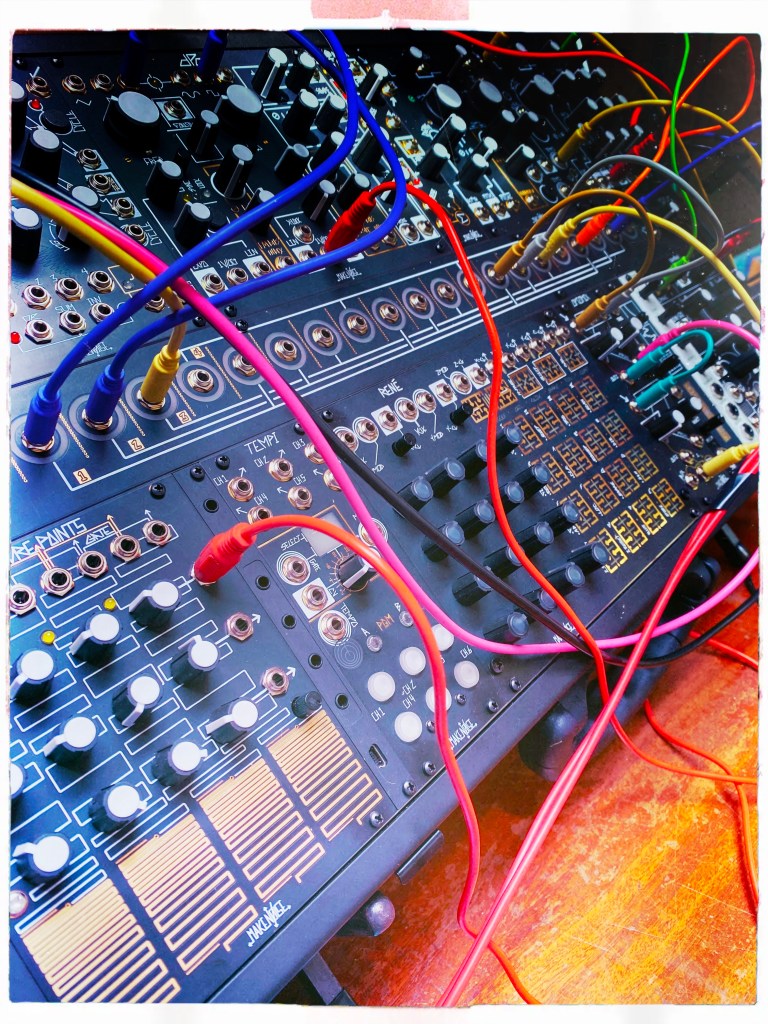
East Anglian electronic explorer, Luke Sanger, kindly leant me his Make Noise Shared System for a bit back in early June, and now you can hear the results.
I spend a long time alone with(in) my system, so inevitably I get stuck in locked grooves, going round in circles, overthinking the same things. Being able to borrow this bonkers and bewitching synth breathed some much-needed fresh air into my modular practice sessions.
Whenever I’m put on the spot about what I love about modular, I often get flustered and forget where I am. “Why do you need to breathe?”, the person may as well have asked. Borrowing this instrument and having to start from scratch on a tight deadline revealed the answer: turns out it’s because I love solving problems; learning things and forgetting them, and then learning them again and remembering them. I enjoy this huge great puzzle with infinite solutions where you can try any approach and none of them are wrong. I love being curious, feeling curious: the rush of being a complete beginner in a world of wonder.
I spent just over a week with Luke’s Shared System, recording eight sessions in as many days; each one becoming a track on new mini-album Starling Sessions, which came out on Friday. Non-stop energetic sounds of new life were my constant companions during this time, synchronous as it was with a pair of starlings raising a brood of chicks right above my head in the roof of the studio! These noisy hatchlings, and the utterly electric calls (if you’re not familiar then do listen to this ornithology YouTube video on starling song or search up your own!) and the perpetual motion of their tireless caregivers (no joke, the parents were in and out of the nest hundreds of times a day on food-gathering missions), rapidly became the inspiration for this suite of miniatures.
The experience also answered some burning questions I’ve had about the distinctive Make Noise sound world that I’ve admired so much in other people’s work. The Make Noise Shared System has now been discontinued by its makers, its modules superseded one by one over the past decade with updated models, influenced by new ideas, technologies and materials. Using this synth is to time travel back to the founding principles of the company’s thinking. There are no voltage-controlled filters; instead you’ve got wavefolding, FM, and complex multi-stage envelopes to carve out and wobble those solid blocks of frequency. There’s a distinctive soft resonance created by a proliferation of low pass gates, their relatively slow response times giving rhythmic patterns a kind of laziness and warmth (these are created by using vactrols laced with cadmium – the use of which is now outlawed or heavily restricted in most countries makes them impossible to include in their contemporary designs). Reverb is deployed in this system as metallic noise assault: the Erbeverb is no dreamboat soother-of-souls, rather it adds rough edges to the most innocent of sounds. This module will shove your unsuspecting music into a claustrophobic chamber lined with freshly-sharpened swords (complimetary). Pitch-shifting spools of delay from Echophon and sprinkled splices of granulation from Morphagene conjure up depth-of-field and polymetric mirage in an otherwise monophonic universe.
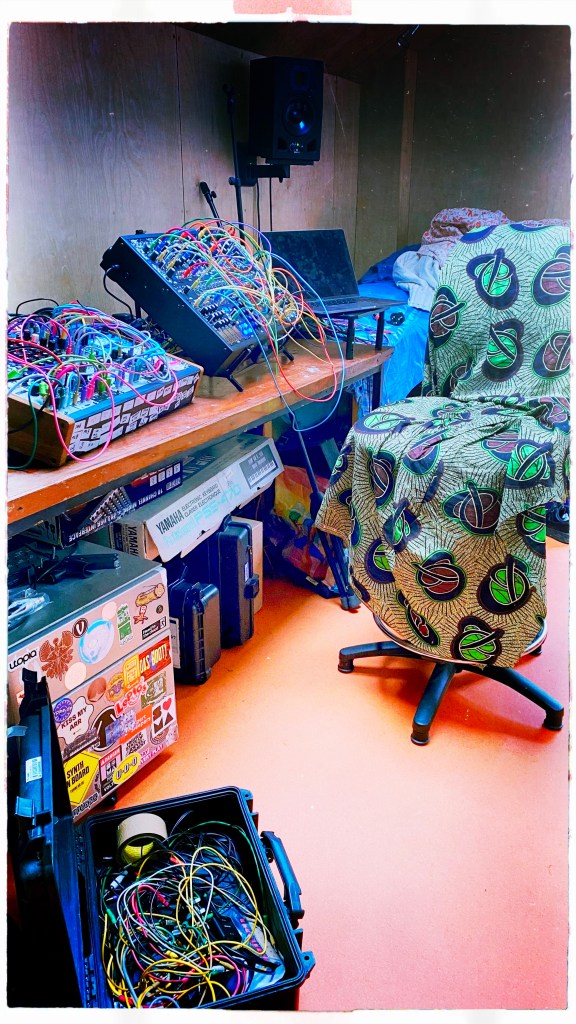
Fun fact: the laptop on the desk was used to watch YouTube tutorials on Maths and Renée with increasing amounts of desperation as I became aware of how fast the sand was trickling through the hour glass. Inevitably I’ve barely scratched the surface of this soundworld and its capabilities!
The Shared System’s oscillator is the fabulous and beastly DPO, which, as of last summer, I now use to great effect in my own system, but I was keen to understand how it worked within its OG universe. Luke’s only addition to the Shared System has been a ‘Pluck’ module from Erica Synths, which adds those very clean fingerpicked-guitar type tones. On my side, I couldn’t help adding my Mimeophon and Bluesky pedal onto the end of the signal path at times, and my trusty Verbos Harmonic Oscillator made an appearance as one of the sound sources in Boing Boing. Finally, for Sister Fledge, I went all out and used my Squid Salmple to add percs and clocked the whole system externally using a DAW so I could edit the session into something resembling a fun techno track!
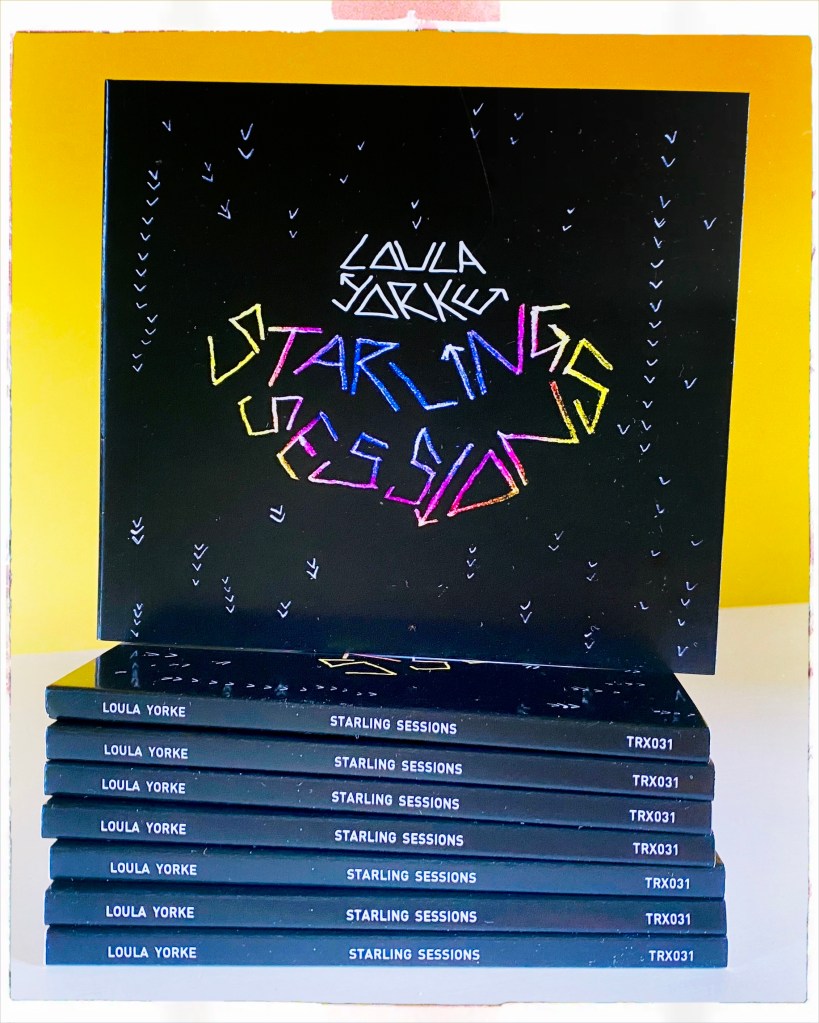
I wanted to get this release turned around quickly so I doodled the artwork myself. I gave a wee nod to the Make Noise faceplate font for the text, clumping up the letters into shapes that echo the murmurations of starling flocks in flight. There are little clusters of white darts in homage to starling chest plumage, and the colourway hopefully brings out a sense of their wonderful iridescent sheen.

